


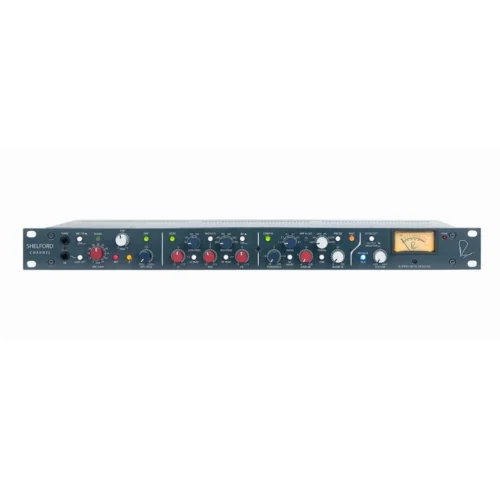
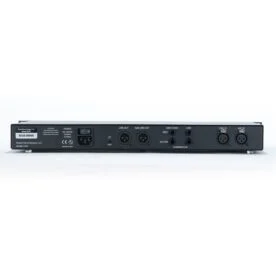
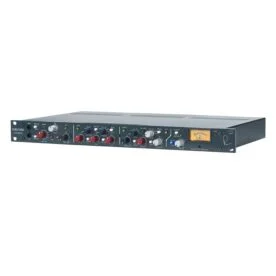


Fifty years of Rupert Neve’s classic sound in one box. The Rupert Neve Designs 5035 Shelford Channel combines a transformer-gain class-A microphone preamplifier, a “best-of-the-classics” inductor EQ, a diode bridge compressor, variable Silk saturation and a custom transformer output stage – running at twice the operating voltage of vintage designs. It is the modern evolution of Rupert’s classic 1073, 1064 and 2254 console modules.
Why customers choose it
Who it is for
Recording and mixing studios, producers and engineers tracking vocals, bass, guitars and drums, and live engineers using it on lead vocals.
Specifications
| Model | 5035 Shelford Channel |
|---|---|
| Format | 1U rack |
| Preamp | Transformer-gain, class-A; 12-step gain (6 dB) + ±6 dB trim |
| Inputs | XLR mic, XLR line, front 1/4″ DI with thru |
| Outputs | XLR line out (transformer), XLR -6 dB out |
| High-pass filter | 20-250 Hz variable |
| EQ | 3-band inductor, ±15 dB; LF shelf/peak, mid with Hi-Q, HF 8/16 kHz |
| Compressor | Diode bridge; threshold +20 to -25 dBu, ratio 1.5:1-8:1, gain -6 to +20 dB, blend |
| Sidechain | Insert send/return (1/4″ TS), sidechain HPF |
| Link | Stereo link with a second Shelford Channel |
| Saturation | Silk Red / Blue with Texture control |
| Metering | VU (output / gain reduction), signal and peak LEDs |
| Power | 100-240 VAC, 50/60 Hz, 35 W max |
| Type | Channel strip (mic pre, EQ, compressor) |
Good to know
- Link two units for stereo compression – the link jacks only work with another Shelford Channel.
- The -6 dB output lets you push the transformer for more colour without clipping your converter.
FAQ
Can I plug a guitar or bass straight in?
Yes, into the front DI input, which shares its design with the RNDI.



 Talk to Suhavi
Reviews
There are no reviews yet.