




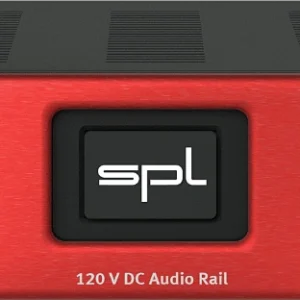
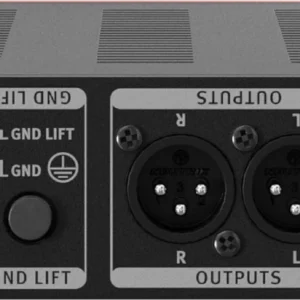


Gemini
Mastering M/S Processor
Gemini is the first mid/side processor in 120V technology. In mastering, M/S processing is often the best way to get targeted access to individual elements of a mix.

M/S ?
The decomposition of the stereo signal in mid (voice, snare, bass …) and side (guitars, pads, cymbals …) allows their separate processing.
The center signal (Mid) is the sum of the left and right channel of the stereo signal (L+R), i.e. the “in phase” part of the stereo signal.
The side signal (Side) is the difference of the left and right channels of the stereo signal (L-R), i.e. the “out-of-phase” part of the stereo signal.
Gemini can also be used to enlarge or reduce the stereo image. An elliptical filter for shifting the low frequency component from the side to the mid is also on board.
The Mid

When the M/S button is activated, the input signal (L/R stereo) is split into a mid and side signals.
The exact center position can be adjusted with the Balance control and the exact level with the Trim control. Both functions are switchable to be in the signal path only when in use.
Exclusive monitoring of the center is possible when the solo function is activated.
Processors can be inserted to process the mid signal and activated with the Insert button.
The Side

The side signal also has a solo function and a switchable insert for external processing.
In addition, the elliptical filter can be used to shift the bass frequencies from the side to the mid. This improves the punch and precision of low frequencies. The Stereo Width control changes the level of the side signal, with a level increase broadening the stereo image.
These two functions can also be switched on to be in the signal path only when used.
I/Os and Inserts

All inputs and outputs as well as sends and returns are balanced using Neutrik XLR connectors.
Processors can be connected to the inserts for external processing.
Especially interesting is the integration of the Gemini into the Hermes Mastering Router. In this way, processing chains can be created that combine classic L/R processing with M/S processing.
Gemini & Hermes

The M/S encoder and decoder stages of the Gemini can each be connected to an insert of the Hermes and freely positioned within the processing chain.
Processors that are in a chain between M/S encoder and decoder process the mid/side signal. These processors can also easily be mono devices.
In the example above, Insert Send A is routed to Gemini for M/S encoding. The mid/side sends of the Gemini go back to Return A of the Hermes.
Send B goes from Hermes back to the Gemini to be encoded back to L/R, which flows from the output of the Gemini back to Return B of Hermes.

For example, it is possible (see figure above) to place the M/S encoder at processing position 3, an equalizer at processing position 4 for separate processing of the mid and side signals, and then the M/S decoder stage of the Gemini at processing position 5 to generate an L/R stereo signal again.
If a compressor is now to be used as an additional device for M/S processing, it can simply be set to processing position 5 in the chain, and the M/S decoder stage would move to processing position 6 accordingly.
The 120V technology
The 120V technology is our reference technology. The 120V technology is unique in the world. It operates at a DC voltage of 120 volts. This is four times that of IC-based semiconductor op-amps.

The highest possible audio quality requires the highest possible audio operating voltage.
The 120V technology works with +/-60 V. To be able to handle such a high voltage, we have developed special proprietary operational amplifiers that can operate with a DC voltage of +/-60 V: the SPL 120V SUPRA operational amplifiers.
This high voltage would destroy conventional components and operational amplifiers.
The 120V technology achieves exceptional technical specifications and sonic benefits. Technically, in terms of dynamic range, signal-to-noise ratio and headroom. Sonically, in terms of richness of detail and an absolutely relaxed listening experience.
By the way, the “120V” in the name of the technology has nothing to do with the local mains voltage from the mains power socket. This is about the operating voltage inside the device with which the audio signals are processed.
The mains voltage from the mains power socket is transformed to the required secondary voltage in the device’s internal linear power supply with toroidal transformer. Rectifiers convert this AC voltage into DC voltage required in the audio device.

The idea for SPL 120V technology and the SUPRA operational amplifier based on this technology were developed in the 1990s by SPL founder and chief developer Wolfgang Neumann.
With the goal of building the best mastering console ever, this basic technological philosophy then took shape for the first time – thus the SPL MMC1 Mastering Console for Galaxy Studios saw the light of day in 2000.
The outstanding sonic and technical features quickly got around in the scene – so further orders were not long in coming.
Besides the MMC 1, another legendary product with 120V technology was created with the PQ, the “King of Parametric Equalizers”.


Since that time, 120V technology has been the foundation for all SPL premium products. Meanwhile, not only for mastering applications, but also for the, studio or hifi use.
Comparison
Most audio devices work with an internal operating voltage of +/-15 volts and can thus process a maximum input level of +21.5 dBu. If a DAC, for example, has an output level of +22 dBu at 0 dBFS, level peaks of the music material would already cause overloads in the input stage of the device.
All components in the audio device often operate at their limits. The result is an unsteady sound that causes stress and faster ear fatigue.
SPL devices with 120V technology can handle input levels of +32.5 dBu thanks to the higher internal operating voltage of +/- 60 volts – thus offering 12 dB more headroom. All components consequently operate continuously in the optimum operating range. The result is a very pleasant, natural and relaxed sound experience. So you can enjoy your music in every detail.
These diagrams clearly show the superiority of the 120V technology in comparison to other circuits with lower, common operating voltages.


In the world of professional audio mastering, precision and clarity are paramount. The SPL Audio Gemini Mastering M/S Processor offers mastering engineers and audio professionals an unparalleled tool to enhance their stereo mixes with exceptional accuracy and control. Whether you are refining a final mix or preparing audio for distribution across multiple platforms, this processor ensures your sound is balanced, detailed, and true to your artistic vision.
One of the key challenges in mastering is maintaining the integrity of the stereo image while making subtle adjustments that improve the overall sound quality. The Gemini Mastering M/S Processor addresses this by providing analog Mid/Side processing capabilities with extremely low noise and distortion levels. This means you can manipulate the center and side elements of your stereo signal independently without introducing unwanted artifacts. As a result, your audio retains its natural dynamics and spatial depth, ensuring a professional and polished final product.
Technically, the processor is built with high-quality analog inputs and outputs that support a maximum gain of 32.5 dBu. This high headroom capacity allows you to work with a wide range of signal levels without risking distortion or clipping, which is essential for preserving audio fidelity. The input impedance stands at 20 kΩ and the output impedance at 75 Ω, optimized for seamless integration with professional studio equipment, minimizing signal loss and ensuring a clean transfer of audio signals throughout your chain.
The Gemini excels in preserving signal purity thanks to its impressive specifications: a frequency range of 10 Hz to 150 kHz (-3 dB), which goes well beyond the audible spectrum, ensuring that no detail is lost during processing. Crosstalk is exceptionally low at -108 dBu at 1 kHz, meaning the left and right channels remain distinct and free from bleed, preserving stereo separation. Total harmonic distortion plus noise (THD + N) is measured at an ultra-low -110 dBu at 0 dBu and 1 kHz, guaranteeing that your audio remains crystal clear. The device’s noise floor, at -98.2 dBu (A-weighted, all stages active), is negligible, allowing even the quietest details in your mix to shine through. With a dynamic range of 135 dB, the processor can handle both the quietest and loudest parts of an audio signal without compression or loss of detail.
Powering the device is an internal linear power supply with a shielded toroidal transformer, operating at analog audio voltages of +/- 60 V. This robust power architecture significantly reduces electromagnetic interference and hum, resulting in a cleaner sound. The device supports selectable mains voltages of 230 V AC / 50 Hz or 115 V AC / 60 Hz, making it versatile for use in studios around the world. Its maximum power consumption is modest at 40 VA, ensuring efficient operation without excessive heat or energy use.
In terms of physical design, the Gemini Mastering M/S Processor measures 482 mm wide, 44 mm high, and 300 mm deep, fitting standard 19-inch rack spaces with a 1U height profile, which is ideal for professional studio environments where space is at a premium. Weighing 5 kg (11.02 lbs), it is solidly built yet manageable for installation and transport.
This processor is ideally suited for mastering engineers, mixing professionals, and audio enthusiasts who demand the highest level of control over their stereo image. It can be seamlessly integrated into analog mastering chains, providing the ability to enhance spatial characteristics and balance without compromising signal quality. Whether you are working on music production, broadcast audio, or film post-production, the Gemini Mastering M/S Processor will elevate your sound to a truly professional standard.
In conclusion, the SPL Audio Gemini Mastering M/S Processor is a premium, meticulously engineered tool designed for those who refuse to settle for anything less than perfection in audio mastering. Its exceptional technical specifications, quiet operation, and flexible power options make it a reliable centerpiece in any mastering setup. Investing in this processor means investing in clarity, precision, and the ability to shape your sound with confidence and finesse.


Reviews
There are no reviews yet.